#India says it attacked nine sites in Pakistan, Pakistani Kashmir. ISLAMABAD —India fired missiles into Pakistani-controlled territory in several locations early Wednesday, killing at least eight people including a child, Pakistani authorities said. India said it was striking infrastructure used by militants.

Tensions have soared between the nuclear-armed neighbors since last month’s massacre of tourists in the Indian-controlled portion of Kashmir. India has blamed Pakistan for backing the militant attack, which Islamabad has denied.

Pakistan’s Prime Minister Shehbaz Sharif condemned Wednesday’s airstrikes and said the “deceitful enemy has carried out cowardly attacks at five locations in Pakistan” and that his country would retaliate.

“Pakistan has every right to give a robust response to this act of war imposed by India, and a strong response is indeed being given,” Sharif said.

He said his country and its armed forces “know very well how to deal with the enemy.”

Sharif has convened a meeting of the National Security Committee for Wednesday morning.

The missiles struck locations in Pakistan-administered Kashmir and in the country’s eastern Punjab province. One hit a mosque in the city of Bahawalpur in Punjab, where a child was killed and a woman and man were injured.

State-run Pakistan Television, quoting security officials, said the country’s air force shot down three Indian jets in retaliation but provided no additional detail. There was no immediate comment from India about Pakistan’s claim.

Pakistan’s Foreign Affairs Ministry said Indian forces had launched the strikes while staying in Indian airspace. Other locations hit were near Muridke in Punjab and Kotli in Pakistan-controlled Kashmir.

It said the attack reportedly resulted in civilian casualties and posed a significant threat to commercial air traffic. “This reckless escalation has brought the two nuclear-armed states closer to a major conflict,” the statement said.

India’s Defense Ministry said at least nine sites were targeted “where terrorist attacks against India have been planned.”

“Our actions have been focused, measured and non-escalatory in nature. No Pakistan military facilities have been targeted,” the statement said, adding that “India has demonstrated considerable restraint in selection of targets and method of execution.”

“We are living up to the commitment that those responsible for this attack will be held accountable,” the statement said.

Stephane Dujarric, the United Nations spokesperson, said in a statement late Tuesday that Secretary-General Antonio Guterres was “very concerned about the Indian military operations across the Line of Control and international border” and called for maximum military restraint from both countries.

“The world cannot afford a military confrontation between India and Pakistan,” the statement read.

In Muzaffarabad, the main city of Pakistan-controlled Kashmir, resident Abdul Sammad, said he heard several explosions and that some people were wounded in the attack. People were seen running in panic and authorities immediately cut the power, leading to a blackout.

The blasts ripped through walls. Locals inspected the damage to their homes in the aftermath of the missile attacks, rubble and other debris crunching underfoot.

People took refuge on the streets and in open areas, fearful of what might happen. “We were afraid the next missile might hit our house,” said Mohammad Ashraf.

Waqar Noor, the region’s interior minister, said authorities have declared an emergency in the region’s hospitals.

Pakistan shut schools in Pakistan-administered Kashmir and Punjab province after the missile strikes. It had already had closed religious seminaries in Kashmir in anticipation of an attack by India.

Along the Line of Control, which divides the disputed region of Kashmir between India and Pakistan, there were heavy exchanges of fire between both armies.

Saaliq reported from New Delhi. Associated Press writers Ishfaq Hussian in Muzaffarabad, Pakistan, Babar Dogar in Lahore, Pakistan, and Asim Tanveer in Multan, Pakistan, contributed to this story.


View 379 times

#Ukraine drone attacks briefly shut down Moscow’s international airports
(In this photo provided by Ukraine's 65th Mechanized Brigade press service, a Ukrainian soldier passes by an armoured Hummer vehicle equipped with an anti-drone net on the front line in the Zaporizhzhia region, Ukraine, Monday, May 5, 2025. (Andriy Andriyenko/Ukraine's 65th Mechanized Brigade via AP) ).


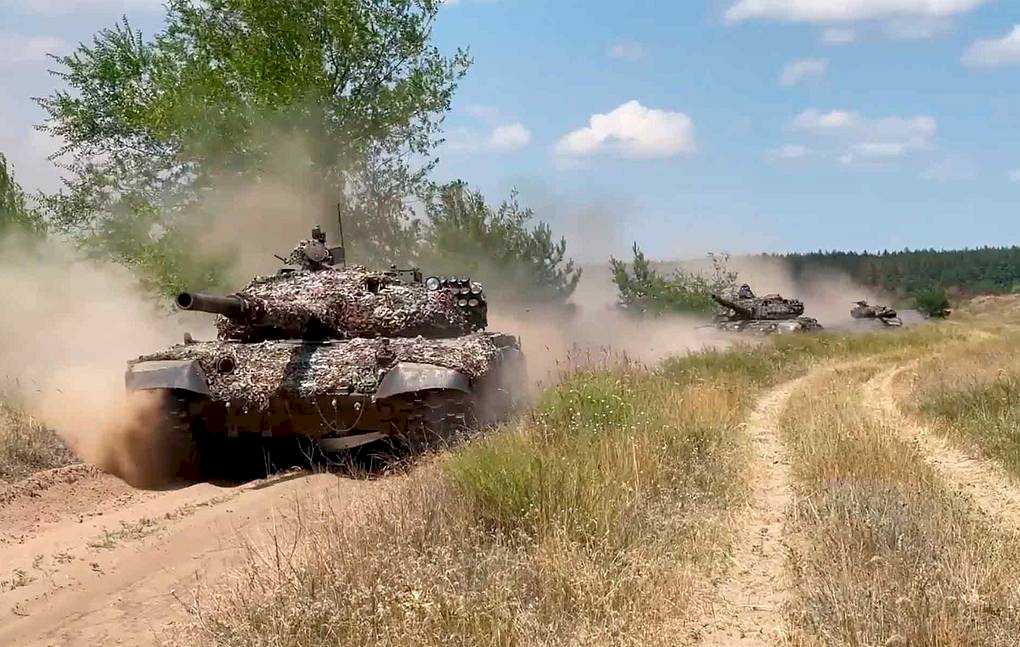
All four international airports around Moscow temporarily suspended flights Tuesday as Russian forces intercepted more than 100 Ukrainian drones fired at almost a dozen Russian regions, the Defence Ministry in Moscow said.

Nine other regional Russian airports also temporarily stopped operating as drones struck areas along the border with Ukraine and deeper inside Russia, according to Russia’s civil aviation agency, Rosaviatsia, and the Defense Ministry. It was the second straight night that the Moscow region reportedly was targeted.

The drone assault threatened a planned unilateral 72-hour ceasefire in the more than three-year war announced by President Vladimir Putin to coincide with celebrations in Moscow marking Victory Day in World War II.

The day celebrating Moscow’s defeat of Nazi Germany in 1945 is Russia’s biggest secular holiday. Chinese President Xi Jinping, Brazilian leader Luiz Inácio Lula da Silva and others will gather in the Russian capital on Thursday for the 80th anniversary and watch a parade featuring thousands of troops accompanied by tanks and missiles.

Security is expected to be tight. Russian officials have warned that internet access could be restricted in Moscow during the celebrations and have told residents not to set off fireworks.

Putin last week declared the brief unilateral truce “on humanitarian grounds” from May 8. Ukraine has demanded a longer ceasefire.

Russia has effectively rejected a U.S. proposal for an immediate and full 30-day halt in the fighting by insisting on far-reaching conditions. Ukraine has accepted that proposal, President Volodymyr Zelenskyy says.

U.S. President Donald Trump said Monday that the brief truce “doesn’t sound like much, but it’s … a lot if you knew where we started from.”

Kremlin spokesperson Dmitry Peskov said Tuesday that ceasefire orders had been issued to Russian troops but soldiers would retaliate if fired upon.

Ukraine has used increasingly sophisticated, domestically produced drones to compensate for having a smaller army than Russia along the roughly 1,000-kilometer (620-mile) front line, and to take the war onto Russian soil with long-range strikes.

Russia has used Shahed drones as well as 3,000-pound (1,300-kilogram) glide bombs, artillery and cruise and ballistic missiles against Ukraine.

Two people were injured in Russia’s Kursk region, according to local Gov. Alexander Khinshtein, and some damage was reported in the Voronezh region.

The Russian reports couldn’t be independently verified.

Meanwhile, the Ukrainian air force said Russia fired 136 strike and decoy drones overnight.

Russian forces fired at least 20 Shahed drones at Kharkiv, Ukraine’s second-largest city near the border with Russia, injuring four people, regional Gov. Oleh Syniehubov wrote on Telegram.

The drones started a fire at the biggest market in Kharkiv, Barabashovo, destroying and damaging around 100 market stalls, he said.

Seven civilians were injured elsewhere in the Kharkiv region by Russian glide bombs and drones, Syniehubov said.

In Kramatorsk, in Ukraine’s eastern Donetsk region, Russian Shahed drones killed one person and injured two others, Mayor Oleksandr Honcharenko wrote on Facebook. The drones targeted residential and industrial areas of the city, he said.

In the Odesa region, Russian drones struck residential buildings and civilian infrastructure, killing one person, regional head Oleh Kiper wrote on Telegram.


View 371 times

How potential U.S. film tariffs could impact Canada’s film industry.

Potential tariffs imposed by U.S. President Donald Trump could affect the Canadian film industry.

Trump announced Sunday that he plans to impose 100 per cent tariffs on all films produced outside the U.S.

“I am authorizing the Department of Commerce, and the United States Trade Representative, to immediately begin the process of instituting a 100% Tariff on any and all Movies coming into our Country that are produced in Foreign Lands,” Trump wrote on his Truth Social platform.

Trump claimed on Truth Social that the movie industry in the U.S. is dying, and with other countries offering incentives to draw filmmakers and studios to their own country, “this is a concerted effort by other Nations and, therefore, a National Security threat.”

With details unclear on how or when these tariffs would be imposed, the Canadian Media Producers Association said Monday in a press release the incoming tariffs could cause “significant disruption and economic hardship to the media production sectors on both sides of the Canada-U.S. border.”

Particularly, Toronto and Vancouver, two major filming hubs commonly known within the industry as “Hollywood North,” could be the cities most likely to be impacted by the proposed film tariffs.
‘Devastating to the film industry’

Toronto’s film industry employs approximately 30,000 people. According to the Alliance of Canadian Cinema, Television, and Radio Artists (ACTRA), Ontario had more than 400 productions in 2023, which created 25,000 jobs and created $1.8 billion in economic activity.

“Hairspray,” “The Incredible Hulk,” “Good Will Hunting,” “Chicago,” “X-Men 4,” “My Big Fat Greek Wedding 2” and “Suicide Squad” are just some of many movies filmed in Toronto.

Toronto Mayor Olivia Chow told CP24 Monday that the tariff announcement surprised her.

“I can’t imagine what it means, what would happen to this industry” Chow said. “We also do a lot of editing work for, again, whether it’s Netflix or Primal or Disney or PBS … I can’t imagine what it means.”

Chow says she hopes something gets sorted out, adding that tariffs could devastate the film industry in both Canada and the U.S.

Trump’s movie tariff would be ‘devastating’ for Toronto’s film industry: Chow

In January, ProdPro, a platform that tracks film and television production trends, released a report that ranks Toronto as the number one preferred location shoot by film executives.

More so, Toronto was named was number one on the annual “best places to live and work as a moviemaker” by MovieMaker Magazine in 2024, which accounts for film commissions, talks with moviemakers, and research into financial incentives, cost of living, and overall happiness and in-person visits.

Toronto is the best place to live and work as a moviemaker this year: report

“What we do provide is a film office to facilitate the making of these beautiful films right here in our incredibly diverse, world-classed city,” Chow said. “It would just make life a lot easier for the companies to be able to find the right people in the right place to do the kind of films they want.”

ACTRA Toronto released a statement Monday that the group is concerned what impacts these tariffs could have on the industry and its members.

“The stated goal is to drive production back to American soil – but the international film community is raising red flags about what this could mean for the global industry, including right here in Canada,” the statement reads.

While tariffs have not come into effect, the statement says the alliance will continue to advocate for its members for “policies that support fair, collaborative production.

Martin Gass, founder and president of the movie studio Prospero Pictures, called the proposed film tariffs “nonsensical.”

“This whole tariff situation is that it will have a chilling effect,” Gass told CTV News Channel Monday. “It’s had a chilling effect on production of automobiles, it’s had a chilling effect on all investment. People don’t know what the law is going to be from one day to the next. What element of the cost of production are you putting a tariff on? How do you calculate this tariff?”
‘We’re going to stand strong‘: B.C. Premier

Vancouver placed in the top five spots on both ProdPro’s January report and MovieMaker Magazine’s 2024, which employs 26,000 people in the film industry and generated $2.7 billion in Gross Domestic Product (GDP) in 2022, according to Creative BC.

B.C. Premier David Eby echoed Chow’s confusion and concern on the proposed film tariffs a press conference Monday.

“The implementation challenges of this are profound and hard to understand exactly how this would work,” Eby said. “There’s no question that the president is threatening people who work in industries across British Columbia and across Canada.”

Eby says that despite what happens, the province will support the B.C. industry, praising the provinces’ success in attracting major talent and film and television shows to shoot in B.C.

According to Eby, popular television series’ “The Last of Us” and “Shogun” will both be shooting another season in B.C.

“We’re proud of the work that we do here, everything from the amazing Hallmark movies right up to the big budget productions,” Eby said. “It’s an important sector for our province and we’re going to stand strong for (film industry workers).”
‘Industry hasn’t been okay since the pandemic’

Although the proposed film tariffs could impact the Canadian film industry, Canadian Screen award-winning actress and filmmaker Aisha Evelyna says the “industry hasn’t been okay since the pandemic.”

“We did see a boom in 2022 when it comes to productions happening here,” Evelyna told CTV News Channel Monday. “However, after the writer’s strike, there’s only more uncertainty.”

Evelyna says while the proposed tariffs are “destabilizing,” she says she hopes the industry could see this as an opportunity.

“Is it possible this is an opportunity for the industry to be more self-sustainable in Canada, more self-generative?” she asked. “We have to champion us. We have the world here. We have languages. We have people. We have the ability to create really great work and find other markets.”

“This is not the first time that the arts have come under attack,” she continued. “Unfortunately, I don’t think it’ll be the last. Maybe this is just the time for us to double down and bet on Canadians and what we can do.”


View 364 times

A #militarized conspiracy theorist group believes radars are ‘weather weapons’ and is trying to destroy them.

U.S. National Weather Service offices around the country are on guard after recent threats to agency infrastructure — specifically Doppler weather radars — from a violent militia-style group, emails from the National Oceanic and Atmospheric Administration’s security office show.

The group Veterans on Patrol, which the Southern Poverty Law Center defines as an anti-government militia organization, views the NWS’ network of Doppler radars as “weather weapons,” according to an internal #NOAA email sent Monday and seen by CNN.

A previous email informing the NWS workforce of general, non-specific threats was sent May 1. Monday’s email was more action-oriented, with the NOAA security office noting they are aware of “several encounters,” physically or virtually, with Veterans on Patrol.

“This group is advocating for anyone and everyone to join them in conducting penetration drills on NEXRAD sites to identify weaknesses which can be used to ultimately destroy the sites,” the email stated, using an acronym for the weather radar network.

“The group referred to the NEXRAD system towers as ‘weather weapons,’ and claimed there were no laws preventing American citizens from destroying the ‘weapons,’” the email states.

It’s unclear what the group believes the radars are doing. The NEXRAD, or “next generation radar,” network has been in place since the 1990s and detects precipitation in the atmosphere. It can also help pinpoint tornadoes and severe thunderstorms, prompting timely, life-saving warnings. The system is also used by the Federal Aviation Administration and the U.S. Air Force.

Among other actions, NOAA’s security office advises that the NWS implement a buddy system when working at remote sites and be alert for suspicious activity.

“Do not engage with anyone suspicious; instead, notify local law enforcement,” Monday’s email states.

The NOAA emails indicate the FBI and other law enforcement authorities are aware of the militia-style group’s activities and are tracking them, and have issued bulletins about the NEXRAD threat. CNN could not independently confirm the FBI’s involvement.

The security threat comes at a time of turmoil for the NWS, with many offices short-staffed due to hundreds of Trump administration layoffs and early retirements.

“Nobody likes federal employees being demeaned by the administration, but when it escalates to violence or threats of it, it starts to become really demoralizing,” said one NWS employee who requested anonymity because they were not authorized to speak to the press.

“We obviously deal with some fringe folks every now and then (chemtrails mostly), but specific threats to target facilities is pretty rare,” the NWS staff member said. “Given the general temperature of the country right now, this is stuff is especially concerning.”

Now would be a particularly inauspicious time for NWS radars to fail, whether due to mechanical issues or deliberate acts, since the agency has more than 90 vacancies for the technicians that normally repair them. That number is unlikely to change soon, since a hiring freeze is in place at the agency.


View 365 times

U.S. Defense Secretary Hegseth to slash senior-most ranks of #military


View 356 times

"While in #Gabon for the inauguration of President Brice Oligui Nguema, I was also pleased to meet with the heads of state of #Rwanda, the Democratic Republic of the Congo, Senegal, Ghana, Guinea Bissau, Equatorial Guinea, Djibouti, and the prime minister of Egypt." U.S. Senior Advisor for #Africa


View 345 times

Who is George Simion, a nationalist who topped polls in Romania’s presidential redo?

George Simion, a nationalist and vocal supporter of U.S. President Donald Trump, won Romania’s first-round presidential election redo by a landslide after capitalizing on widespread anti-establishment sentiment.

The 38-year-old leader of the hard-right Alliance for the Unity of Romanians, or AUR, will face a pro-western reformist in a May 18 runoff that could reshape the European Union and NATO member country’s geopolitical direction.

Romania’s political landscape was upended last year when a top court voided the previous election in which the far-right outsider Calin Georgescu topped first round. The decision followed allegations of electoral violations and Russian interference, which Moscow has denied.

“For 35 years, the Romanian people lived the lie that we are a democratic country,” Simion, who came fourth in last year’s race and later backed Georgescu, told The Associated Press last week. “And now the people are awakening.”
Who is George Simion?

Born in 1986 in Romania’s eastern city of Focsani, Simion took a bachelor’s degree in business and administration in Bucharest, and later a master’s degree at a university in the northeastern city of Iasi researching communist-era crimes. He also became involved in soccer ultra groups.

He took part in civic activism, including joining a protest movement against a controversial gold mining project by a Canadian company in a mountainous western region of Romania that contains some of Europe’s largest gold deposits. He also campaigned for reunification with neighboring Moldova.

In 2019, Simion founded the AUR party, which rose to prominence in a 2020 parliamentary election by proclaiming to stand for “family, nation, faith, and freedom,” and has since doubled its support to become Romania’s second largest party in the legislature.

He supports Trump, and he told AP last week that the AUR party is “perfectly aligned with the MAGA movement.”

The party opposes same-sex marriage and has close ties to the Romanian Orthodox Church.
What does the MAGA-style populist stand for?

Simion’s political platform has been built on a fiercely anti-establishment agenda and populist rhetoric. During the COVID-19 pandemic, his party staged multiple protests against vaccination and lockdowns, capitalizing on a widespread distrust of the authorities.

He labelled the canceled election last year a “coup d’etat,” and adopted stronger populist rhetoric and religious messaging to tap into Georgescu’s electorate. He has branded Romania’s current political system as a “hybrid regime” that failed to deliver democracy after the 1989 revolution toppled communism.

“They voted for the change, and they were not allowed to make this change,” he told the AP. “This is why I’m running again as a duty towards democracy, towards the constitutional order, to restore the rule of law, to restore the will of the Romanian people.”

A Simion presidency would pose unique foreign policy conundrums. He is banned from entering two neighboring countries, Moldova and Ukraine, over security concerns. “It is in their interest to have good relations with us,” he said.

In March, Simion also sparked controversy after remarking during a protest that those responsible for barring Georgescu’s second bid for presidency should be “skinned in a public square,” prompting prosecutors to launch a criminal probe for inciting violence. He denied the accusation saying it was a political metaphor.
What are his stances on the EU and NATO?

Observers have long viewed him of being pro-Russian and warn that his presidency would undermine both Brussels and NATO as the war rages on in Ukraine. He refuted the accusations as a “smear campaign” by leftists and said Russia has been the “main threat” to Romania in the last 200 years and remains so today.

“This is why we need a strong #NATO and we need troops on the ground in Romania, in Poland and in the Baltic states,” he said, although he was against sending further military aid to Ukraine.

“The danger is not who will be the next president of Romania but … those who want to create a distance and to form two different opposing geopolitical blocs" between the European Union and the U.S., he said.

On the EU, Simion said, “We want more power to the 27 states, not toward the European institutions,” and that he is “totally aligned” with the position of Italian Prime Minister Giorgia Meloni, who was the only EU head of government to attend Trump’s inauguration in January.
What do his critics say?

Siegfried Muresan, a Romanian member of the European Parliament, said Monday that a Simion presidency would be “bad news” for Romania and Europe, and accused the AUR leader of having ”disdain for democratic processes.”

“George Simion is not a conservative politician. He is an anti-European extremist. His election would endanger Romania, threaten European stability, and serve as a strategic victory for Russia,” he said. “He offers no viable solutions to Romania’s challenges.”

For Claudiu Tufis, an associate professor of political science at the University of Bucharest, accusations that Simion is extremist or pro-Russian are overblown. He says a Simion presidency could look similar to Hungary’s Prime Minister Viktor Orbán, who has long been a thorn in the side of Brussels.

“My main criticism has to do first with his values. He’s a strong opponent of any sort of what people are considering to be identity politics, so he’s going to push back very hard on LGBT issues and gender issues,” Tufis told AP.

He added that Simion lacks a strong team to deal with major crises. “When it comes to dealing with geopolitical crisis, they are completely unauthorly unprepared,” he said.

Article written by Stephen Mcgrath, The Associated Press


View 345 times

Former U.S. Vice President Pence defends Constitution after getting Profile in Courage Award


View 338 times

US President Donald Trump said Sunday he was ordering new tariffs on all films made outside the United States, claiming Hollywood was being "devastated" by a trend of US filmmakers and studios working abroad.


View 328 times

Immortal Regiment procession held in Washington D.C. Participants walked from the White House to the World War II memorial on the central boulevard of the US capital


View 325 times