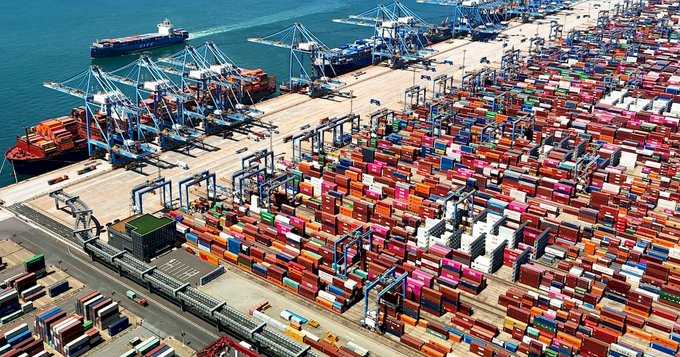

#Oil prices reach wartime high as #Iran and U.S. tanker blockades remain. Follow for live updates here. Both Iran and the U.S. have blocked the Strait of Hormuz, a critical shipping artery that in peacetime sees about 20 per cent of worldwide crude shipments.

Gas in B.C. now costs more than C$2/L, with prices elsewhere not far behind.

U.S. wants to work with Canada on energy trade: sources

United States Trade Representative Jamieson Greer told Canadians looking for insights into the future of bilateral trade this week that “America First” is policy, not a slogan, and they should not expect a return to the way things were.

Sources who attended a roundtable with U.S. President Donald Trump’s trade czar in Washington on Wednesday told The Canadian Press that Greer was measured and pragmatic as he laid out the administration’s policy goals ahead of the coming review of the Canada-U.S.-Mexico-Agreement on trade, better known as CUSMA.

About 40 people attended the event hosted by the American Chamber of Commerce in Canada, including Conservative MPs Jamil Jivani, Michael Chong and Shuv Majumdar. Also in the room were multiple executives from oil and gas companies.

Canada’s Ambassador to the U.S. Mark Wiseman sat two seats away from Greer during the meeting. Alberta’s Washington trade representative Nathan Cooper and Manitoba’s trade representative Richard Madan were also in attendance.

Greer said the United States is looking to work with Canada on energy and critical minerals development in ways that would be mutually beneficial to both countries, the sources said.

One source said Greer cautioned that Canada should not attempt to use those resources as leverage in negotiations on the trilateral trade pact.


Canada is a major oil producer. Why are prices so high?

Canada is the fourth-largest oil producer in the world. It produced 5.13 million barrels of oil per day on average in 2024 and 5.19 million barrels per day in the first half of 2025, according to a snapshot released in December.

But if that’s the case, why are our fuel prices going up just like the rest of the world?

“Oil and gas are global commodities,” economist Moshe Lander explained during an interview with CTV News Channel.

Consider an oil exporter in Canada who sells to the domestic market and internationally, he said. Since every country in the world purchases oil, or some derivative, Canada’s local prices are influenced by whatever the highest price is elsewhere in the world.

And because oil is refined into so many different products, such as fuel for our cars, jets, plastics and more, all those prices stand to rise as well.


View 137 times

What is #OPEC+ and how does it affect oil prices?

The Organization of the Petroleum #Exporting Countries and allies, including Russia, are known collectively as OPEC+. Last year, the group produced nearly 50 per cent of the world’s oil and oil liquids, according to International Energy Agency estimates. The UAE is the fourth largest producer in OPEC+.

Below are facts about OPEC+ and its role.

What are #OPEC and OPEC+?

OPEC was founded in 1960 in Baghdad by Iraq, Iran, Kuwait, Venezuela and Saudi Arabia with the aims of coordinating petroleum policies and securing fair and stable prices. Today, it includes 12 countries, mainly from the Middle East. The UAE joined in 1967.

The UAE is the fourth producer to leave the group in recent years, and by far the biggest. Angola, which joined OPEC in 2007, quit the bloc at the start of 2024, citing disagreements over production levels. Ecuador quit OPEC in 2020 and Qatar in 2019.

The group produced over half of global crude in the 1970s, according to Reuters calculations, before the onset of non-OPEC supply sources such as the North Sea.

In later decades, OPEC’s share stood at between 30 per cent and 40 per cent but record output growth from rivals such as the United States has steadily eaten into that share.

OPEC in 2016 sought to regain influence by forming an alliance with 10 non-members, including Russia, which it called OPEC+.

As a result, its market share increased to around 51.15 million bpd, or nearly 50 per cent of global oil and oil liquids production, in 2025, according to the International Energy Agency. In March, a month into the Iran war, that share fell to about 44 per cent.
U.S.-Iran war reduces UAE production

Before the start of the U.S.-Iran war at the end of February, the UAE was producing 3.3 million bpd and had capacity to be able to produce as much as 4.5-5.0 million bpd of crude and oil liquids.

Its importance in OPEC in the past was increased because, together with leading OPEC member Saudi Arabia, it had spare capacity that it could add to the market if required.

That has become academic since the unprecedented oil market disruption caused by the effective closure of the Strait of Hormuz since the Iran war.

Gulf OPEC+ crude oil production fell by nearly 8 million barrels per day in March versus February as Saudi Arabia, the UAE, Kuwait and Iraq cut output, according to OPEC.

The cuts were necessary because they were limited in how much they could export, although both have some ability to bypass the Strait of Hormuz.

Saudi Arabia has a 7 million bpd pipeline to the Red Sea while the UAE can export 1.5-1.8 million bpd through a pipeline to the port of Fujairah.
OPEC and global oil prices

OPEC+ says it cuts and raises oil production to balance the markets.

Its critics say the group manipulates prices, which OPEC denies.

During the 1973 Arab-Israeli War, Arab members of OPEC imposed an embargo against the United States in retaliation for its decision to re-supply the Israeli military, as well as other countries that supported Israel. The embargo banned petroleum exports to those nations.

The oil embargo pressured an already strained U.S. economy that had grown dependent on imported oil. Oil prices jumped, causing high fuel costs for consumers and fuel shortages. The embargo also brought the United States and other countries to the brink of a global recession.

U.S. President Donald Trump has accused the organization of “ripping off the rest of the world” by inflating oil prices. Trump has also linked U.S. military support to the Gulf with oil prices, saying that while the U.S. defends OPEC members, they “exploit this by imposing high oil prices.”

However, it was Trump who helped to convince OPEC+ to cut output in 2020 during the COVID pandemic as crude oil prices slumped and U.S. oil producers suffered.

In 2025, OPEC crude exports accounted for about 47 per cent of global crude seaborne exports, according to Kpler. In March, that share shrunk to 34.7 per cent, Kpler data show.
Which countries are OPEC members?

The current members of OPEC are: Saudi Arabia, United Arab Emirates, Kuwait, Iraq, Iran, Algeria, Libya, Nigeria, Congo, Equatorial Guinea, Gabon and Venezuela. The UAE said it would leave the group on May 1.

Non-OPEC countries in the global alliance of OPEC+ are represented by Russia, Azerbaijan, Kazakhstan, Bahrain, Brunei, Malaysia, Mexico, Oman, South Sudan, Sudan and Brazil, which joined in early 2025.

Sources: Reuters News, World Economic Forum website, OPEC website, U.S. Department of State website, the International Energy Agency.

#Trade,#UmojjaTrade

Reporting by Ahmad Ghaddar and Yousef Saba; Editing by Barbara Lewis.


View 142 times

Singapore-based company chosen as potential buyer for Yukon mine after collapse


View 141 times

Canadian manufacturers call for tariffs on global imports of wood products


View 136 times

#OTTAWA — Prime Minister Mark Carney’s new advisory council on Canada—U.S. trade met for the first time today, ahead of trade negotiations with President Donald Trump’s White House that are set to begin over the coming months.

Carney recently struck the new committee in preparation for the scheduled review of the Canada-United States-Mexico agreement on trade, better known as CUSMA, which must start by July.

Canada-U.S. Trade Minister Dominic LeBlanc chaired the closed-door meeting of the council’s roughly two dozen members, which include leading Canadian business and labour leaders.

LeBlanc’s office says the committee reviewed Canada’s priorities for CUSMA renewal talks but did not say what those priorities are.

The trade advisory group includes former Conservative party leader Erin O’Toole and former premiers Jean Charest and P.J. Akeeagok.

The advisory panel also welcomed a new member today: Eliot Pence, the founder of the Canadian defence tech firm Dominion Dynamics.

This report by The Canadian Press .


View 130 times

Le #Bénin se penche sur l’adressage numérique, pour fluidifier les transports et la logistique urbaines


View 141 times

Nigerian Gas Association forum calls for clearer regulations, disciplined implementation and alignment to boost investment and unlock gas sector growth.


View 142 times

The US has extended its ceasefire with Iran to allow more time for negotiations, despite uncertainty over Tehran’s response; the future of Druzhba pipeline oil supplies remains unclear as political disputes over #EU funding and sanctions persist; and Russia’s seaborne oil exports have rebounded after weeks of decline thanks to recovering shipments in the Baltic. These stories topped Wednesday’s newspaper headlines across Russia. #TradeNews


View 140 times

#Afreximbank report says poor infrastructure drives high #logistics costs in #Africa, limiting intra-African #trade, which remains far below global levels.


View 141 times

U.S. forces board a sanctioned oil tanker in the Indian Ocean, the Pentagon says. The Tifani was captured in the Bay of Bengal — between India and Southeast Asia — and was carrying Iranian oil, according to a U.S. defence official who spoke on condition of anonymity to discuss an ongoing military operation. The U.S. military will decide in the next four days what to do with the vessel, such as tow it back to the U.S. or turn it over to another country, the official said.

It’s the latest move in the U.S. war on Iran to stop any ship tied to Tehran or those suspected of carrying supplies that could help its government, from weapons and oil to metals and electronics. The announcement comes ahead of the expiration of an already tenuous ceasefire between the U.S. and Iran, and as Pakistan attempts to broker talks between Washington and Tehran.

It is the second vessel linked to Iran that has been interdicted by the U.S. military. The U.S. navy attacked and seized an Iranian-flagged cargo ship Sunday that it said had tried to evade its blockade of Iranian ports, with U.S. President Donald Trump saying an American destroyer blew a hole in the ship’s engine room.


View 142 times