
#Scientists find yeast in ancient Iceman’s guts — and make bread. More than 5,300 years ago — before the Egyptian pyramids were built — Oetzi was strolling through the Alps on the border of Austria and Italy when he was killed by an arrow in the back.

He remained frozen in the ice until two German hikers stumbled across his mummified remains in 1991 in the northern Italian region of South Tyrol.

Since then, his stunningly well-preserved remains have been kept at the same temperature — minus six degrees Celsius — as his icy tomb.

This has allowed scientists to carefully study Oetzi, who offers an incredibly rare window into ancient human life.

For the latest research, published in the Microbiome journal on Wednesday, an Italy-based team found evidence that both ancient and modern microbial life remain active in the frozen body.

“What we didn’t expect to find was yeast,” lead study author Mohamed Sarhan of the Eurac Research institute in the Italian city of Bolzano told AFP.
‘Very good sourdough’

The scientists discovered four different yeasts that can survive sub-zero temperatures in Oetzi’s guts, skin and “brownish” water that melted off his body when he was partially unfrozen.

These kinds of yeast only live in very cold conditions such as Antarctica, so are believed to have entered Oetzi’s body at some point after he died.

Genetic analysis revealed “DNA damage levels very comparable to the original microbes” in the Iceman’s guts, suggesting the yeast entered his body soon after death, Sarhan said.

“These yeasts have accompanied Oetzi on his long journey through the millennia,” study co-author Frank Maixner said in a statement.

The scientists then reproduced the gut yeast in a fridge.

“If you tell anyone you have yeast, they immediately ask: can we use it for bread?” Sarhan said.

So they tried to make a sourdough loaf.

“Initially it didn’t work,” the microbiologist admitted.

But after three months of effort “we had a very, very good sourdough,” Sarhan said with a laugh.

When asked if the scientists were considering using the yeast to brew beer, he responded: “It’s on the list.”

The study contained more serious possible uses for the yeast.

When the mummy was found in 1991, it was initially treated as a normal cadaver. A chemical called phenol was used to stop fungus from growing in the body.

However the strange yeast was able to eat the phenol, meaning that in the future it could help break down the chemical in contaminated environments, the scientists said.
Inside the ancient microbiome

The yeast was not the only surprising discovery in Oetzi’s body.

An analysis of his microbiome revealed a particular kind of a gut bacteria that is almost non-existent among modern humans.

Though gone from the stomachs of people in the industrialized world, the bacteria has been detected among tribes in Africa and South America, Sarhan said.

It has also been found in 3,000-year-old faeces preserved in a salt mine in Hallstatt, Austria — which serves as one of the only other available views into the ancient human microbiome.

Oetzi and these Bronze Age salt miners ate more fibre and whole grain than modern-day people, Sarhan explained.

The study said it “reveals that the Iceman is not a biologically ‘frozen’ time-capsule but rather a complex ecosystem”.

It is too early to say whether the yeast is harming the mummy, Sarhan said, calling for more research.

Nikolay Oskolkov, a researcher at the Latvian Institute of Organic Synthesis not involved in the study, told AFP it was interesting that “the Iceman’s microbiome is not ‘frozen’”.

However Oskolkov, who previously discovered ancient fungus in the mummy’s guts, cautioned that the yeast samples were only taken in 2010 and 2019.

This provides “very little evidence that the yeasts have been multiplying over millennia,” he said, adding that he believed they were “relatively recent colonists of the mummy’s body.”

Daniel Lawler, AFP


View 96 times

#Researchers train dogs to detect ‘silent killer’ canine cancer. Researchers at the Penn Vet Working Dog Center in South Philadelphia are training dogs to help detect hemangiosarcoma, a form of canine cancer.

The dogs learn how to identify the cancer by smelling three boxes, with one containing a sample of malignant blood.

“It really does feel like magic because I can’t smell anything from the samples. It’s a tiny drop of blood serum,” Clara Wilson, a researcher at the Working Dog Center, said. “We wanted to focus on hemangiosarcoma, which is a really devastating canine cancer.”

Hemangiosarcoma is a tumor that is often called the silent killer because it grows in the body and goes unnoticed until it’s too late.

In the first phase of the research, the dogs identified the cancer 70% of the time. And when they get it right, they get a treat.

Until now, the research primarily focused on human cancers, with the dogs being able to identify ovarian and pancreatic cancer.

“Dogs are very unique because they have this incredible sense of smell,” Wilson said. “It just really does feel amazing and gives me a lot of respect for understanding that there’s a lot of things that I can’t understand that they’re picking up on.”

Once the dogs identify the cancer, researchers look for markers in the samples that could eventually be used to create a test that would find the cancer early, when it’s more treatable.

“The idea is that if dogs can smell something, that means that there’s a signal to detect,” Wilson said.

These dogs are laying the groundwork for eventually being able to find cancer early and save lives for both humans and animals.

The working dog center also trains dogs to detect drugs, bombs and alert for medical conditions.


View 163 times

Scientists have discovered the largest organic molecule containing sulfur — a key ingredient for life — ever identified in interstellar space. The researchers call the discovery a “missing link” in scientists’ understanding of the cosmic origins of life’s chemistry.

Sulfur is the 10th most abundant element in the universe and a critical component of amino acids, proteins and enzymes on Earth. But while researchers had previously found sulfur-bearing molecules similar to the newly discovered one in comets and meteorites, there was a puzzling lack of large molecules including sulfur in interstellar space — the vast region between stars that is scattered with clouds of dust and gas.

“Sulfur came to Earth from space long, long ago,” said Mitsunori Araki, a scientist at the Max Planck Institute for Extraterrestrial Physics in Germany and lead author of a study on the discovery, which was published last week in the journal Nature Astronomy.

“However, we have only found a very limited amount of sulfur-bearing molecules in space, which is strange. It should exist in huge amounts, but it’s very difficult to find.”

A different team of researchers previously suggested that sulfur might appear to be rare in space because it’s trapped in cosmic ice — hiding in plain sight rather than missing.

The new detection, therefore, adds an important piece to this puzzle. “This is the largest sulfur-bearing molecule ever found in space, at 13 atoms,” Araki said. “Before this one, the largest only had nine atoms, but it was already a rare case, because most detected sulfur-bearing molecules only had three, four or five atoms.”

Finding larger molecules is important, he added, because it helps to fill an existing gap between simple chemistry found in space and the more complex building blocks of life that have been discovered in comets and meteorites.

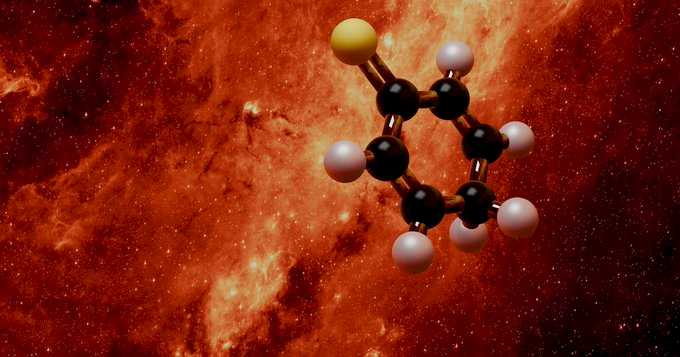
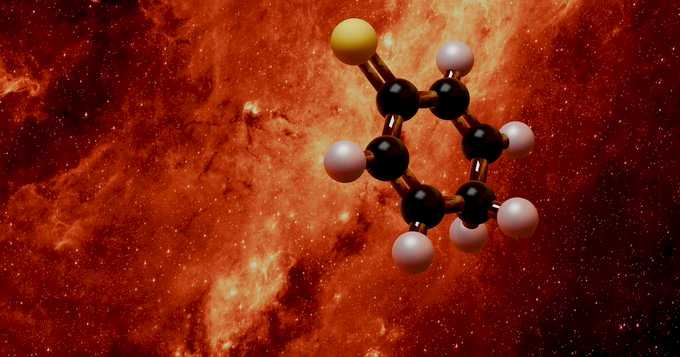
The molecule, which also contains carbon and hydrogen, is called 2,5-cyclohexadiene-1-thione and adds to a growing catalog of over 300 molecules observed in space so far. The finding, Araki said, suggests that many more molecules containing sulfur, perhaps even larger, could be detected in the future.
Stellar nurseries

The molecule was found within a molecular cloud called G+0.693–0.027 about 27,000 light years from Earth, near the center of our galaxy.

Molecular clouds are cold and dense concentrations of dust and gas that allow for the formation of molecules. They act as stellar nurseries as gravity creates clumps that eventually become baby stars.

“A molecular cloud is where star formation is happening,” said Valerio Lattanzi, also a scientist at the Max Planck Institute for Extraterrestrial Physics and a coauthor of the study.

Eventually, Lattanzi added, some of these clouds will lead to the formation of planetary systems like our own solar system. “The ingredients that are embedded in the molecular cloud will be transferred to the planets,” he said.

“We are trying to find out what the ingredients that will eventually form life are, trying to understand how from simple molecules we get to life as we know it on Earth. And we are trying to add elements to this picture, one by one.”

Researchers first synthesized the molecule by applying an electric discharge to a substance called thiophenol — a foul-smelling liquid containing sulfur, carbon and hydrogen.

They then obtained an extremely precise “radio fingerprint” of the molecule that they compared with existing telescope data from the observation of the cloud, collected by the IRAM-30m and the Yebes radio telescopes in Spain.

“We had seen from earlier observation that sulfur molecules were quite abundant in this cloud,” Lattanzi said. “That’s why it was a very good target for us. We believe that one of the possible origins of life on Earth is through collisions and impacts of small body systems like comets and meteorites with our planet in the past, that probably brought complex molecules, including ones containing sulfur. So that’s what we are trying to do — to connect these missing links in the path to eventually form life as we know it.”
‘An exciting detective story’

Kate Freeman, Evan Pugh University Professor of Geosciences at Penn State University, called the study “an exciting detective story made possible by powerful radio telescopes and a really good search strategy.”

Meteorites are known to have large and complex sulfur compounds, said Freeman, who was not involved in the research, and they likely delivered many of them to Earth to help set the stage for the chemistry of life.

“Yet, we didn’t really know how these compounds ended up in meteorites or their precursor planetary bodies,” she added in an email. “Now we know there is at least a good possibility some of them could be derived from outside the solar system, from molecule-rich regions of our galaxy like the area studied by the authors.”

Sulfur is one of only six elements essential to life on Earth and may have been a critical ingredient in the earliest life on Earth, providing vital fuel to ancient microbes, according to Sara Russell, a professor of planetary sciences at the Natural History Museum in London.

“The presence of complex organic molecules in the centre of our Milky Way implies that biologically important materials may be everywhere in space,” Russell, who did not participate in the study, said in an email.

“Finding such molecules such a long way from our home planet also suggests that similar processes may be happening elsewhere — it makes the presence of life existing on another planet that little bit more likely.”

Ryan Fortenberry, an associate professor of chemistry and biochemistry at the University of Mississippi, said the findings excited him. “Sulfur as an atom exists in a very special place on the periodic table.

It has a unique chemistry that allows molecules to do much more than what only oxygen, nitrogen, and carbon would allow,” Fortenberry said via email. “Finding molecules with sulfur in them helps us to better gauge where life could’ve started, and where it could end up.”

More than 50 years ago it was a miracle to find any molecules in space, added Fortenberry, who was also not part of the study.

“The common thinking was that the harsh environment would simply break them down — now we’re finding molecules with 13 atoms and some with multiple dozen atoms,” he said.

“#Molecules are more resilient than we gave them credit for, and telescopes have shown us that the chemistry of space is far richer than we could have imagined. I fully expect that we will find amino acids in space beyond our solar system.”


View 164 times